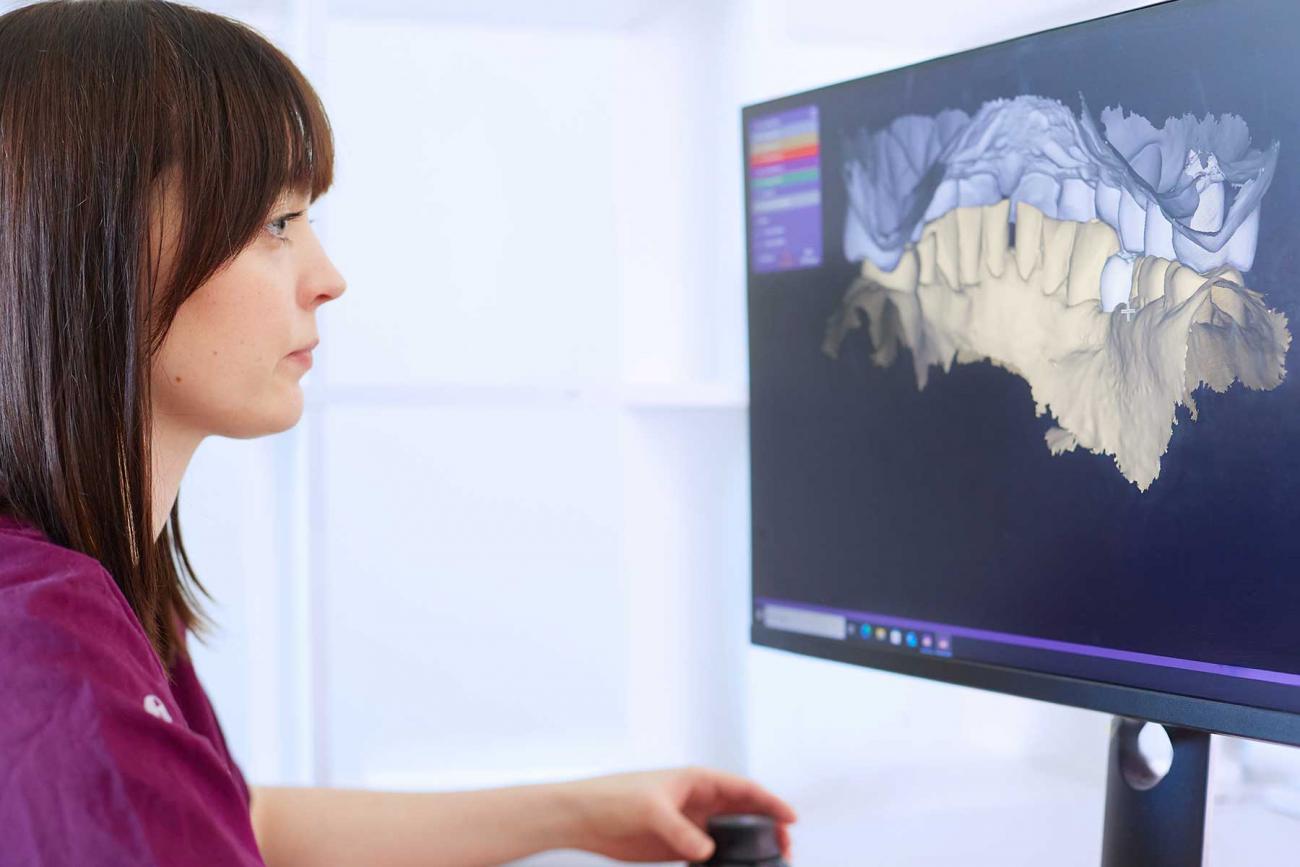
Digital dentistry is changing the way treatments are planned and implemented.
Digital dentistry is the rapid innovation process at the interface between the laboratory and patient treatment. The aim is to link analog treatments with analog processing in the laboratory in a highly precise manner in the sense of a data transfer chain, rather than replacing them. Accordingly, the so-called digital workflow is limited to the processing chain between treatments that have to be performed entirely by hand. Until now, the digital workflow, which has been proven over several years, has often been reduced to CAD (computer-aided design) and CAM (computer-aided manufacturing). With CAI (computer-aided imaging), intraoral scanning, additional sources of error caused by the digitization of impressions or models have been significantly reduced. The progress in the development of intraoral scanning systems has been enormous.
Precision
Precision in terms of accuracy and repeatability, in addition to increased efficiency, can be used as evaluation parameters for this innovative achievement. Indirect restorations, manufactured on the basis of intraorally collected and digitally processed surface data (STL – Standard Triangulation Language), can be produced with comparable precision and reproducibility using current intraoral scanning and milling and grinding techniques as with the classic analog processing chain. In particular, with model-free processing of CAD/CAM-manufactured all-ceramic restorations, the fit accuracy is higher when the data is generated directly intraorally rather than via a scanned impression. Even higher fitting accuracy can be achieved for single tooth and quadrant restorations. The aspect of efficiency in particular shows advantages for the digital process chain, and from the patient's perspective, intraoral scanning is preferable to conventional impressions.
Efficiency
3D printing is another fundamental component of digital data processing. Only with the help of CAP (computer-aided printing) is it possible to cover the entire range of indications, from printed working models to the production of bite splints and drilling templates based on digital data sets.
Safety
Printing drilling templates for implantology is particularly efficient. The occlusal screw connection of monolithic hybrid abutment crowns primarily requires prosthetically oriented implant axis alignment so that the screw channel is located in the center of the crown in order to ensure the minimum circular thickness of the ceramic. With the help of template-guided implantation, the prosthetically oriented implant alignment required for this type of restoration can be achieved with sufficient accuracy.